 Merry Japan Tours
BLOG
New Year exploration of things unique to Japan
Japanese people enthusiastically celebrate the New Year’s Holidays, especially the first three days of the new year because we want to wipe the slate clean of the old year and welcome the new year with an exhilarating state of mind. To many Japanese people, the New Year’s Holiday is the longest holiday, followed by another holiday observed from the end of April through the first week of May, called “Golden Week”. Modern Japanese people splurge on clothes, cuisine, and events during the New Year’s Holidays. Children dress up and behave themselves during this occasion because they are anticipating “Otoshi-dama,” or monetary gifts from their parents and other older relatives. With the money, they may purchase “Fukubukuro,” or Lucky Bags, and go out for some special events or festivals at a Shinto shrine.
The New Year’s Holidays are the days when we welcome “Toshigamisama,” or mountain gods into our homes, so we clean up on New Year’s Eve, wiping glass doors thoroughly, and festoon our homes with special New Year’s ornaments like “Kagamimochi,” which are layers of round rice cakes, “Shimekazari,” or New Year’s sacred straw, hung at the entrances of our homes. “Kadomatsu,” is another special New Year’s decoration mainly made up of pine and bamboo. Here is a cultural obligation: we decorate our homes with such special ornaments at least two days prior to New Year’s Day because we can show our dedication to the mountain gods through the decorations.
It’s a big deal if we can’t ring in the new year and ring out the old one, so lots of preparations are always underway ahead of the new year. For instance, we spend a lot of time, making “Osechi-ryori,” which is a three-layered box of New Year’s cuisine.
Now, I’d like to share my exploration of things unique to Japan that can be seen during the New Year’s Holidays. By reading this article, you will get to know the essence of one of the unique occasions rooted in the distant past, New Year’s Holidays!
Contents
- 1 Kadomatsu, a special New Year’s decoration placed at the entrance to welcome a mountain god
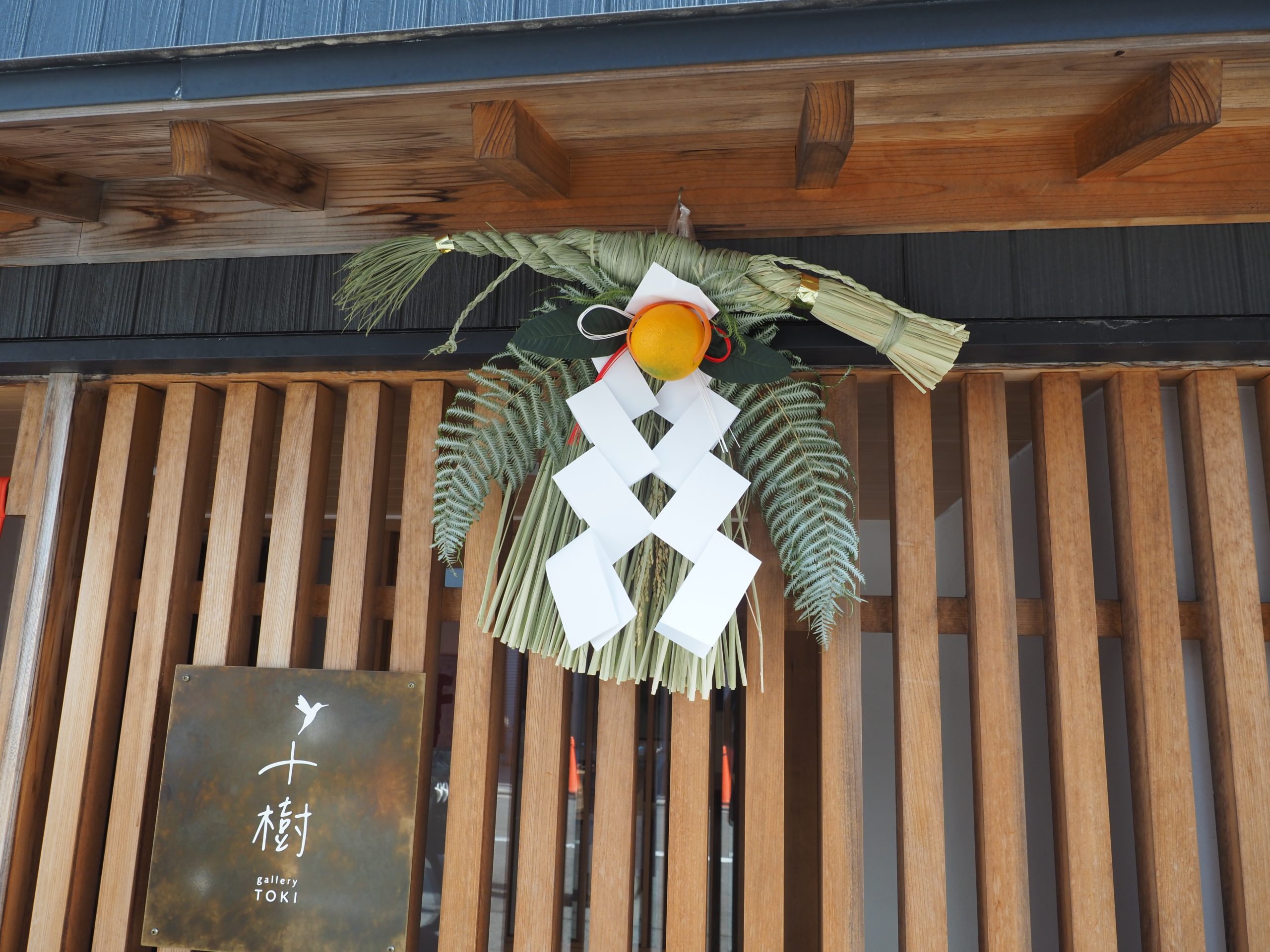
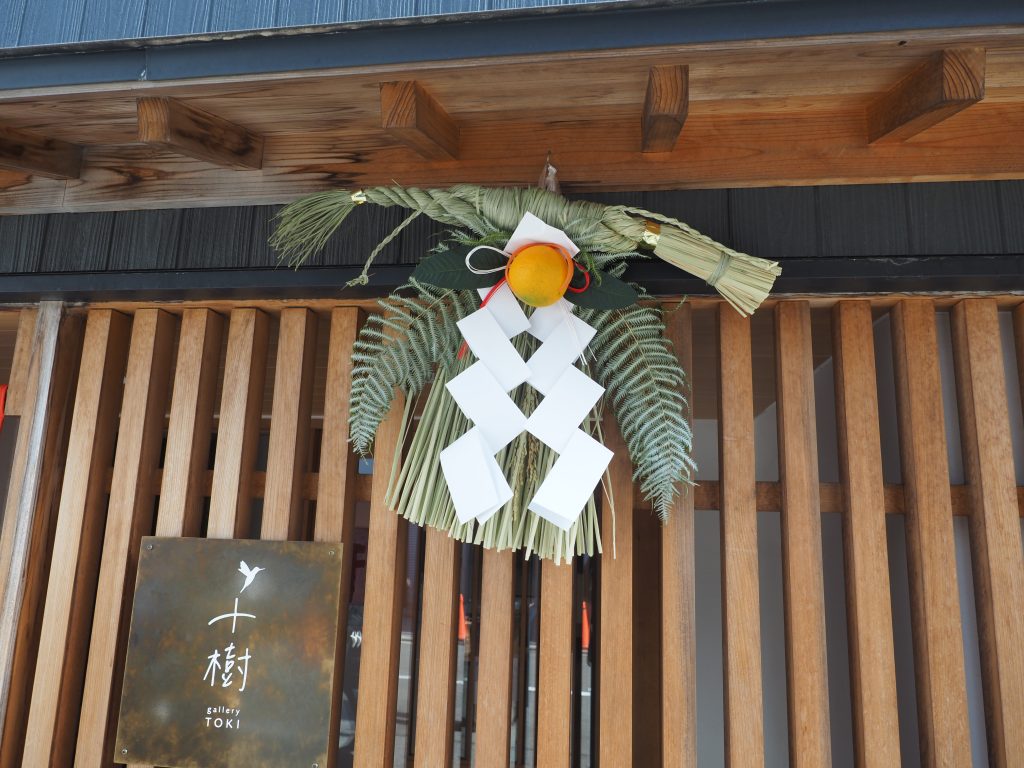
- 2 Shimekazari, a sacred straw decoration hung at the entrance to welcome a mountain god
- 3 Sake is a must when it comes to the New Year’s Holidays.
- 4 Osechi-ryori, three-layered cuisine boxes that are designed to last for the first three days of the new year.
- 5 Kagami-mochi, layers of round rice cakes eaten with the hope that family members will be healthy all year round.
Kadomatsu, a special New Year’s decoration placed at the entrance to welcome a mountain god
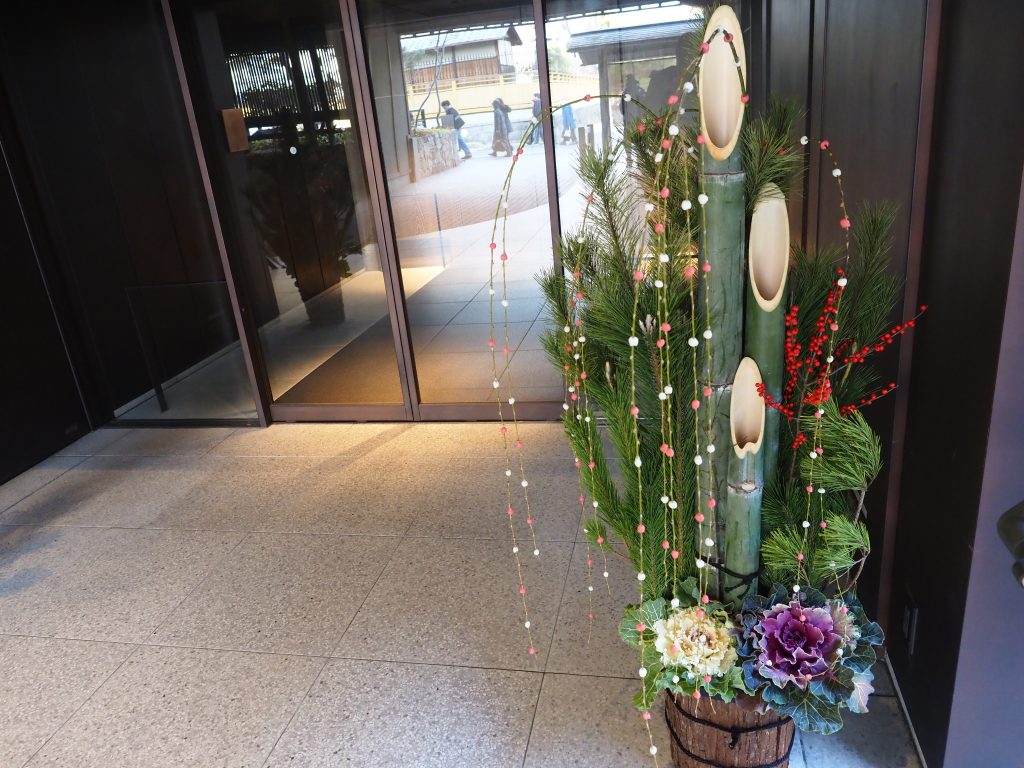
To start with, one of the biggest reasons why we celebrate the new year is to welcome the “Toshigamisama-god” into our homes, who is believed to reside in a mountain—even though the vast majority of the Japanese don’t have this fundamental knowledge. The mountain god is said to come to purified places, so that’s why we Japanese dedicate ourselves to cleaning up our homes. Not only do we clear our homes of dust, but we also decorate the entrances of our homes, restaurants, and hotels with special ornaments to let the mountain god know that the place has been purified.
Among New Year’s decorations, the most impressive one is surely Kadomatsu, a special decoration which is made up of pine and bamboo and placed at the entrance. Since the distant past, the Japanese have considered bamboo, pine, and plum to be the three lucky plants. Pine signifies longevity, bamboo; constancy, and plum; purity.
We place a Kadomatsu on either side of the entrance. The pair of Kadomatsu is also considered to be effective at warding off evil spirits. It makes sense because evil spirits may be threatened by the sharpened bamboo ornament.
Whenever we see Kadomatsu, we feel that the new year has arrived, and some may even be fascinated by its aesthetic value. Indeed, some luxury hotels, department stores, and restaurants incorporate this custom into their business with a view to attracting more customers with the help of the mountain god.
Shimekazari, a sacred straw decoration hung at the entrance to welcome a mountain god

Shimekazari is a sacred straw decoration consisting of a daidai orange, a zigzag strip of white paper, and Yuzuriha leaves. This special ornament is hung at the entrance to welcome a mountain god and ward off evil spirits. The purpose of Shimekazari is the same as Kadomatsu, but Shimekazari is more common for ordinary families or restaurant owners to decorate with, so you can find lots of Shimekazari all over during the New Year’s Holidays.
The Daidai orange signifies prosperity over generations, the zigzag strip of white paper; thunder to intimidate evil spirits, and Yuzuriha leaves; generation change, or the prosperity of descendants.
We should keep in mind that all the decorations for the new year should be taken down by the 15th of January in the Kansai region, which encompasses, among others, Kyoto, Osaka, and Nara, because mountain gods are said to return to the mountain by that date. This custom of taking down special ornaments differs according to region. For instance, people in Okinawa take down special ornaments by the 14th of January.
So, some Westerners might wonder how to dispose of such special ornaments. In principle, we need to take them to a nearby Shinto shrine. Come January 15th, local Shinto shrines hold a fire festival, called “Dondon-yaki,” literally meaning “burning on end” where Shinto priests put fire to the special ornaments and burn them to ashes. Some people might feel it’s a waste, but using old ornaments for the next year is considered rude to Shinto deities, something which we should avoid if we want to be rewarded.
Sake is a must when it comes to the New Year’s Holidays.
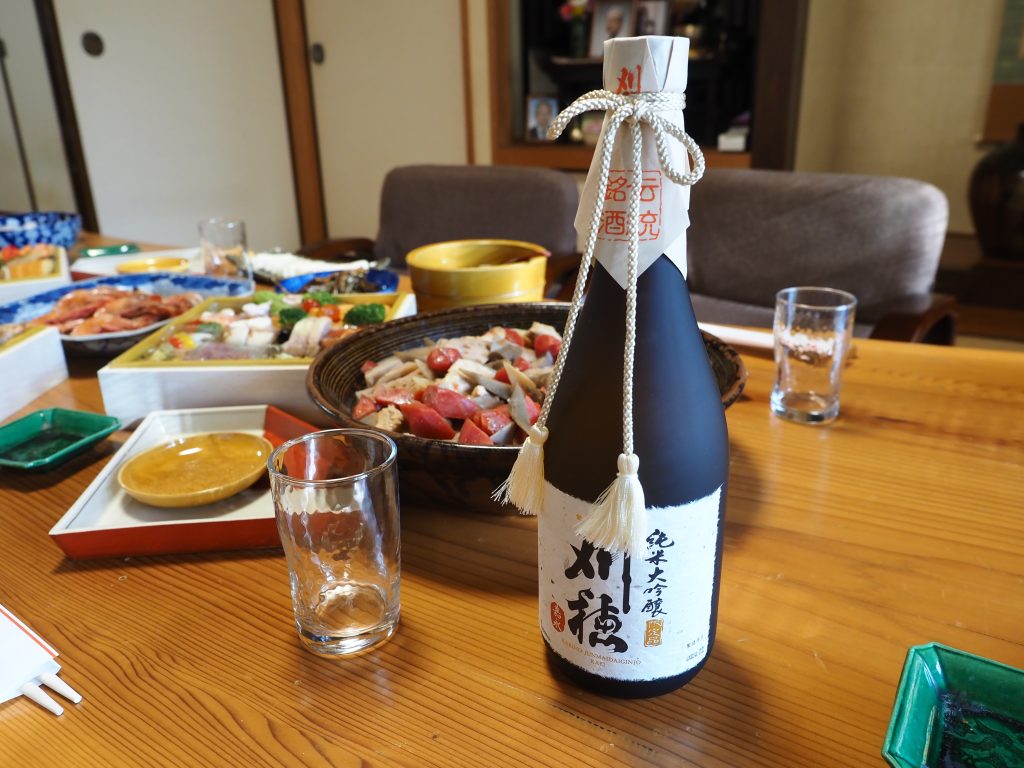
Drinking sake is an indispensable part of the New Year’s Holidays. We buy bottles of sake ahead of New Year’s Day to celebrate the new year.
Sake is sacred because it is the fruit of accumulated efforts made not only by sake brewers but also by farmers who grow rice suitable for sake manufacturing. In addition, for making sake, good-quality water and a good climate for rice are keys to producing high-quality sake, so sake-making always comes with reverence for Shinto deities. During this season, we can see lots of casks of sake or bottles of sake donated to Shinto deities at Shinto shrines. This demonstrates that we Japanese have the utmost appreciation for Shinto deities for good harvests, business prosperity, safety in the household, and the like. Such sake donated to Shinto deities is called “Omiki,” and after a festive ritual is conducted by Shinto priests, Omiki is offered by Shinto maidens to visitors to Shinto shrines. On this occasion, you need to take three sips after a Shinto maiden says “Go ahead.”
To further demonstrate more cultural details, we Japanese go so far as to pour sake for the deceased. This is because we want to enjoy imagining we drink sake with late family members. Such behavior can be observed not only during the New Year’s Holidays but since New Year’s Day is the most important day for Japanese people, we enjoy drinking sake with the imaginary attendance of the deceased.
Osechi-ryori, three-layered cuisine boxes that are designed to last for the first three days of the new year.
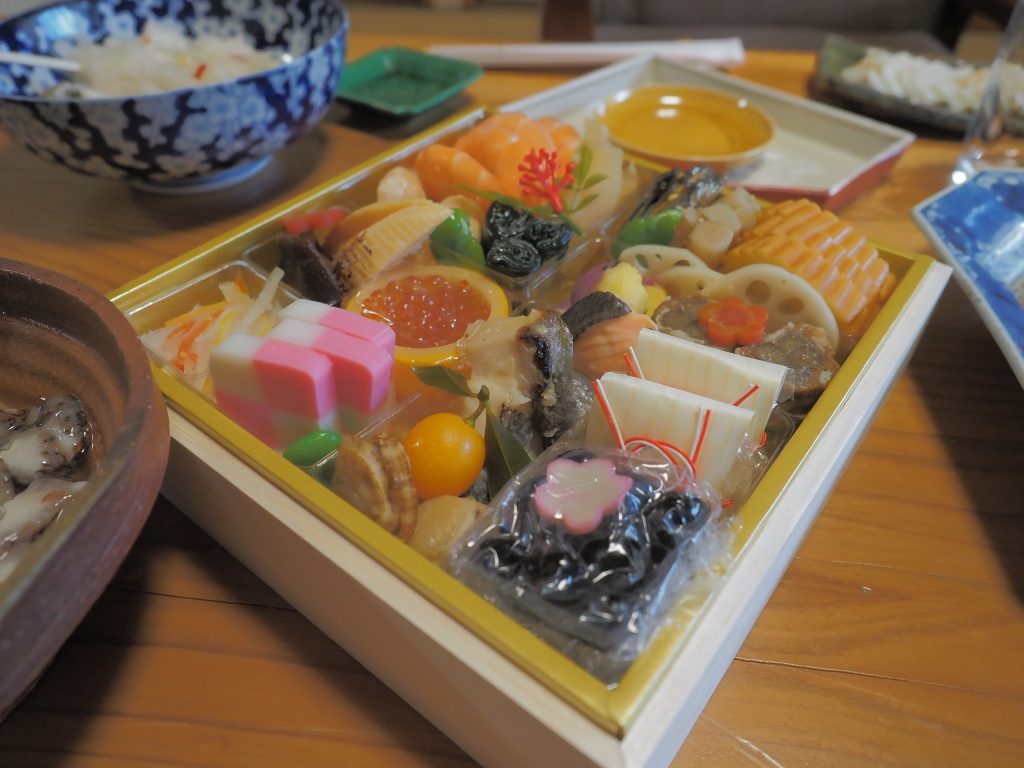
These days, lots of Japanese people arrange for Osechi-ryori from luxury restaurants to be delivered ahead of New Year’s Day. But, since some Japanese feel Osechi is not enough, they make additional meals. To cook such meals, housewives stay up late at night, delaying sleep in order to ensure the meals are completed on time.
Indeed, Osechi is a traditional cuisine that is designed to be stretched over three days. In the past, Japanese people endured their hunger by nibbling at Osechi during the first three days of the new year because they were culturally recommended that they shouldn’t kill any living creature during this period.
Now, it has become common among modern Japanese that we can eat meat on New Year’s Day, so some restaurants are open from New Year’s Day right through the holiday. We put various ingredients including herring roe, lotus roots, and sweetened black beans into the three-layered boxes, and each of the ingredients has its own meaning. Eating herring roe is believed to make us blessed with fertility, and lotus roots are eaten so we will be able to have a good prospect for the future since we can look through the holes of lotus roots, signifying that we can look ahead to the future through the holes. So, to put it in a metaphorical way, lotus root is like a telescope that commands a view of the future. Sweetened black beans are eaten because they are believed to encourage us to be more diligent.
Kagami-mochi, layers of round rice cakes eaten with the hope that family members will be healthy all year round.
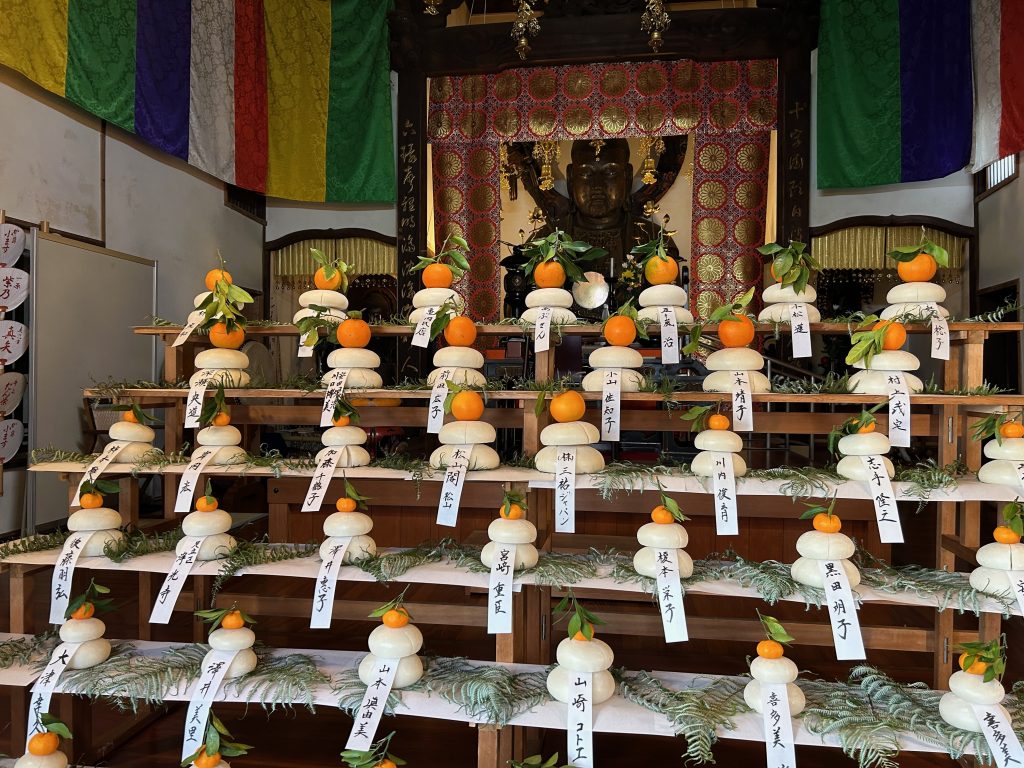
Kagami-mochi is a round rice cake mainly consisting of two layers. We can buy Kagami-mochi at local supermarkets and put them on a Buddhist altar or a Shinto altar before eating them because a mountain god is believed to enter Kagami-mochi. These rice cakes are far from being mere decorations. They’re in fact more of an offering to Shinto deities. After the mountain god resides inside Kagami-mochi, we are allowed to receive happiness by eating them.
Two round mochi are piled up because we Japanese consider anything stacked as being auspicious. Indeed, the two round mochi signify the sun and the moon.
To eat Kagami-mochi, cultured Japanese people never use a knife to separate them because it is associated with “Seppuku,” or self-disembowelment. To those who don’t know the term Seppuku, this custom may be appalling, but it was considered the most honorable way of dying. Execution or exile might have been a loss of face to Samurai warriors. Anyway, we should avoid using a knife to separate Kagami-mochi. Instead, we break them apart using our hands.
We pray for good health during the New Year holidays by eating Kagami-mochi. Also, we pray for longevity because biting off the rice cake requires robust teeth. We can cook various dishes using the rice cake with the spirit of a mountain god believed to be inside of it. One of the most famous sweets is “Oshiruko,” which is a bowl of sweetened red beans and mochi rice cake. We warm up our bodies by having this precious sweet mainly served during the New Year Holidays.
Article in same category