 Merry Japan Tours
BLOG
FIVE CULTURAL EXPERIENCES YOU MUST HAVE AT FUSHIMI-INARI SHRINE
Legend has it that the original construction of Fushimi-inari Shrine, the headquarters of all the Inari shrines across Japan, dates back to 711. At that time, one of the descendants of the Hata clan, who brought back the knowledge of rice cultivation, enjoyed doing archery with a target made from a rice cake with a deity believed to be residing inside of it.
Such a prank somehow disturbed the condition of the deity. Suddenly, the rice cake turned into an egret and flew to the top of a mountain where the incorrigible guy followed. According to the legend, he then found the egret giving birth to rice plants. This is believed to be one of the mysteries which shroud the origin of this Shinto shrine. Here are what are believed to be the top five cultural experiences that can be found at the shrine.
Contents
A tower gate that is designated a national treasure
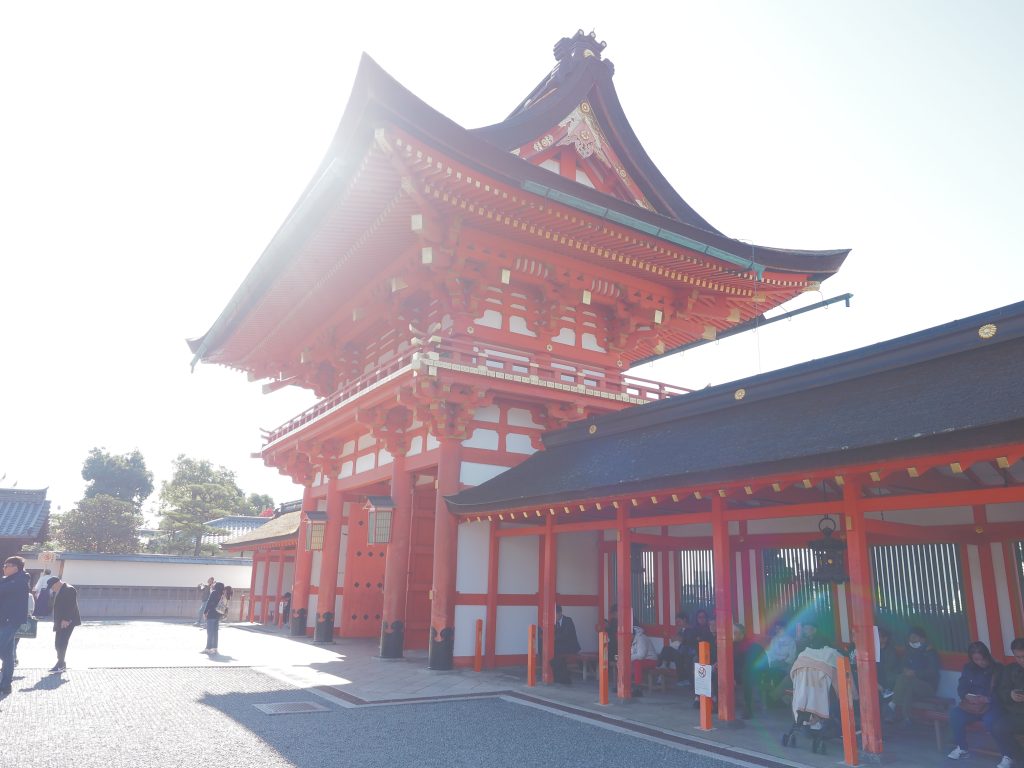
To everyone’s surprise, a huge tower gate wholeheartedly welcomes your arrival at Fushimi-inari Shrine, causing you to stop briefly to take photos. This tower gate, the oldest and largest in Kyoto is designated an important national treasure.
Looking back on the Japanese warring states period, the warlord who succeeded in unifying Japan, Toyotomi Hideyoshi, had his men construct this building. He had prayed that if his mother recovered from an illness, he would contribute tons of straw bags filled with rice to this shrine.
Fortunately, she recovered from her illness, and Hideyoshi was so delighted that he also put a lot of money into the reconstruction work of the Shinto buildings which had been severely damaged during the Onin war. The tower gate we see today was completed in 1589 to return the favor of the Inari gods.
If you just go through this gate without stopping, you would pass up the opportunity to look at the details of this beautiful structure where you could find something unique to Japan. So, it’s recommended that you take a look at this building from every angle to enjoy it to the fullest.
Needless to say, you will understand why this place was once a shooting location for a Japanese romantic movie, titled “My Tomorrow, Your Yesterday.”
A sub-shrine dedicated to a god of study
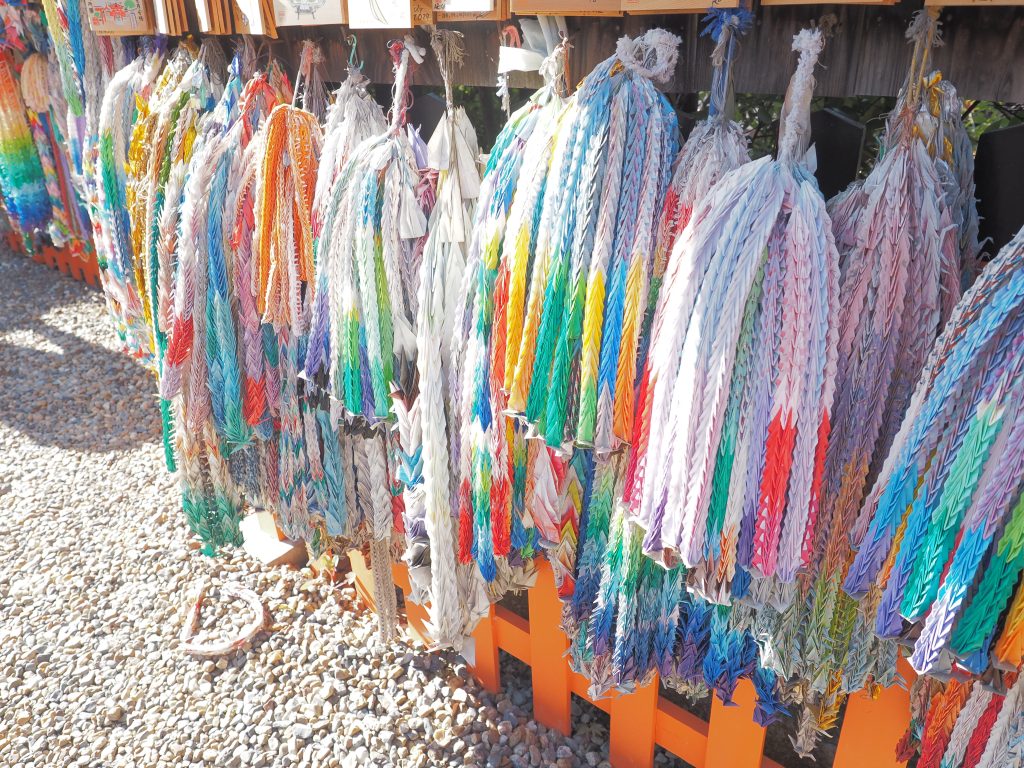
After immersing yourself in the structural beauty and romance provided by the tower gate, dropping in at a sub-shrine which is dedicated to a god of study, located within the compound of Fushimi-inari Shrine, would be the way to go. There, you will be mesmerized by numerous very colorful objects; a thousand paper cranes that required a lot of time and effort to make.
Think of a family where a son will take an entrance exam for a prestigious university. He can’t possibly make a thousand paper cranes himself because he naturally has to dedicate himself to studying. Instead, his parents or relatives make a thousand paper cranes on his behalf to express dedication to him and of course to a god of study with the hope that he will pass the exam.
Their sincere efforts making them and their heartfelt wish will definitely be rewarded because the deity enshrined in this sub-shrine used to be one of the greatest scholars of the Japanese classics during the Edo period. His studies, among others, included the study of the Japanese chronicle and Japanese literature. This was against the backdrop of lots of other scholars focusing on Chinese classics.
Even if one of your family members has yet to make plans for a university or certification, this place will be a must because you are allowed to take memorable photos with a thousand paper cranes surrounding you.
A dazzling array of torii gates
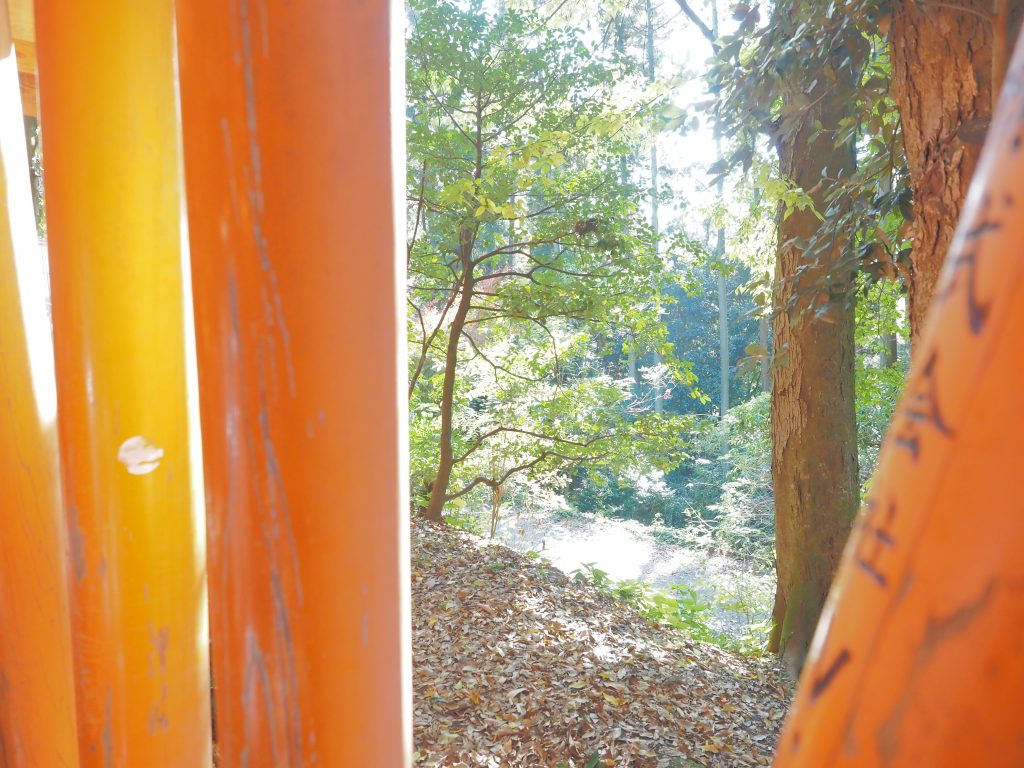
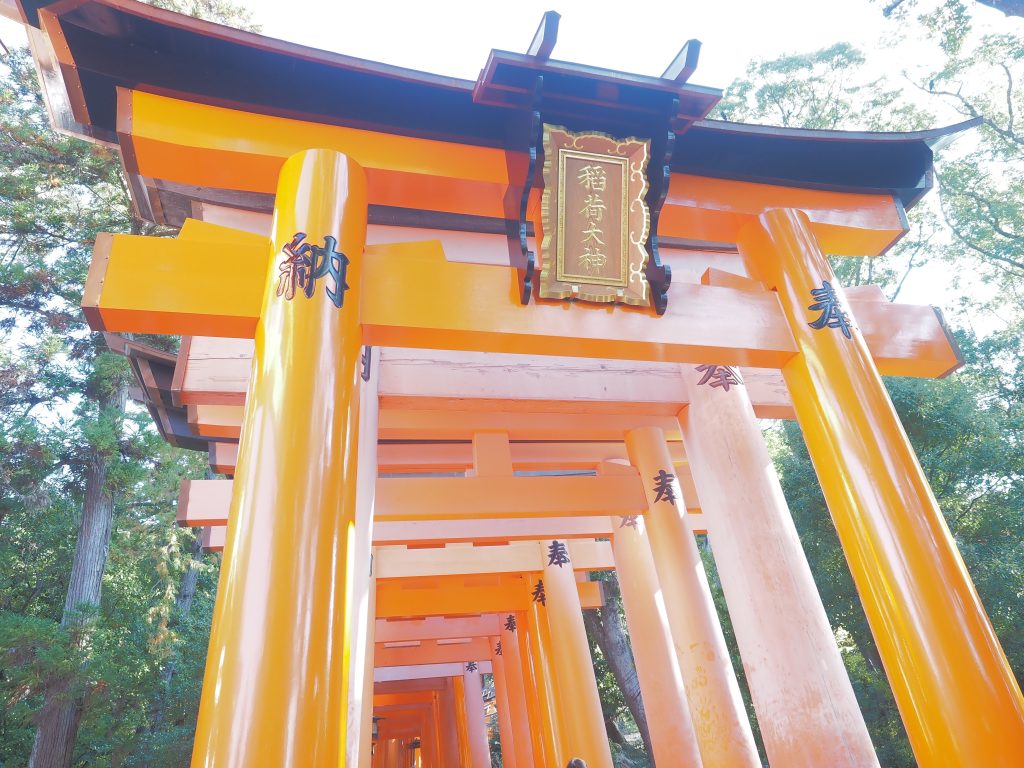
Arriving in front of the world-famous dazzling array of torii gates leading up to the top of the mountain is breathtaking.
The torii gates in this Shinto shrine were originally donations made by people in Japan but most recently, they have also included donations by people from all around the globe. The donation amount differs according to the size of the torii gate, ranging from around 100,000 yen to over a million yen. So, some financially challenged people might not be able to afford to do that. That being said, since everyone can’t afford such an expensive contribution, they could settle for buying a miniaturized Torii gate on which they can write their wishes, and then take it home with them.
Torii gates are donated as a token of gratitude for the benefits derived from the Inari gods or in anticipation of being rewarded in the future.
The color of the Torii gates is always vermilion because evil spirits are said to dislike the color. By adopting the color scheme, demons keep away from the sacred precincts. You might feel a little dizzy walking through all of the Torii gates on the way to the mountain top, as is sometimes the case with Japanese climbers, but you can take a short break in vantage spots that are located between the base and the summit.
You should allocate about an hour if you want to make it to the top of the mountain, but it takes stamina, so please take into account your physical condition and mental health.
Mysterious statues of a fox
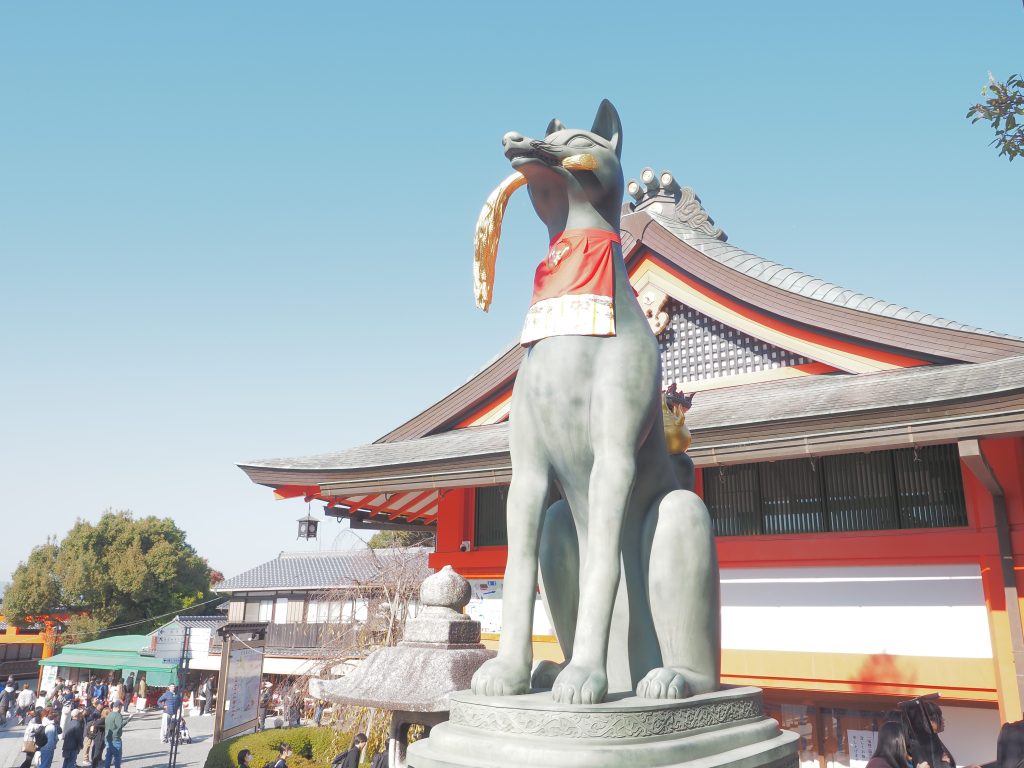
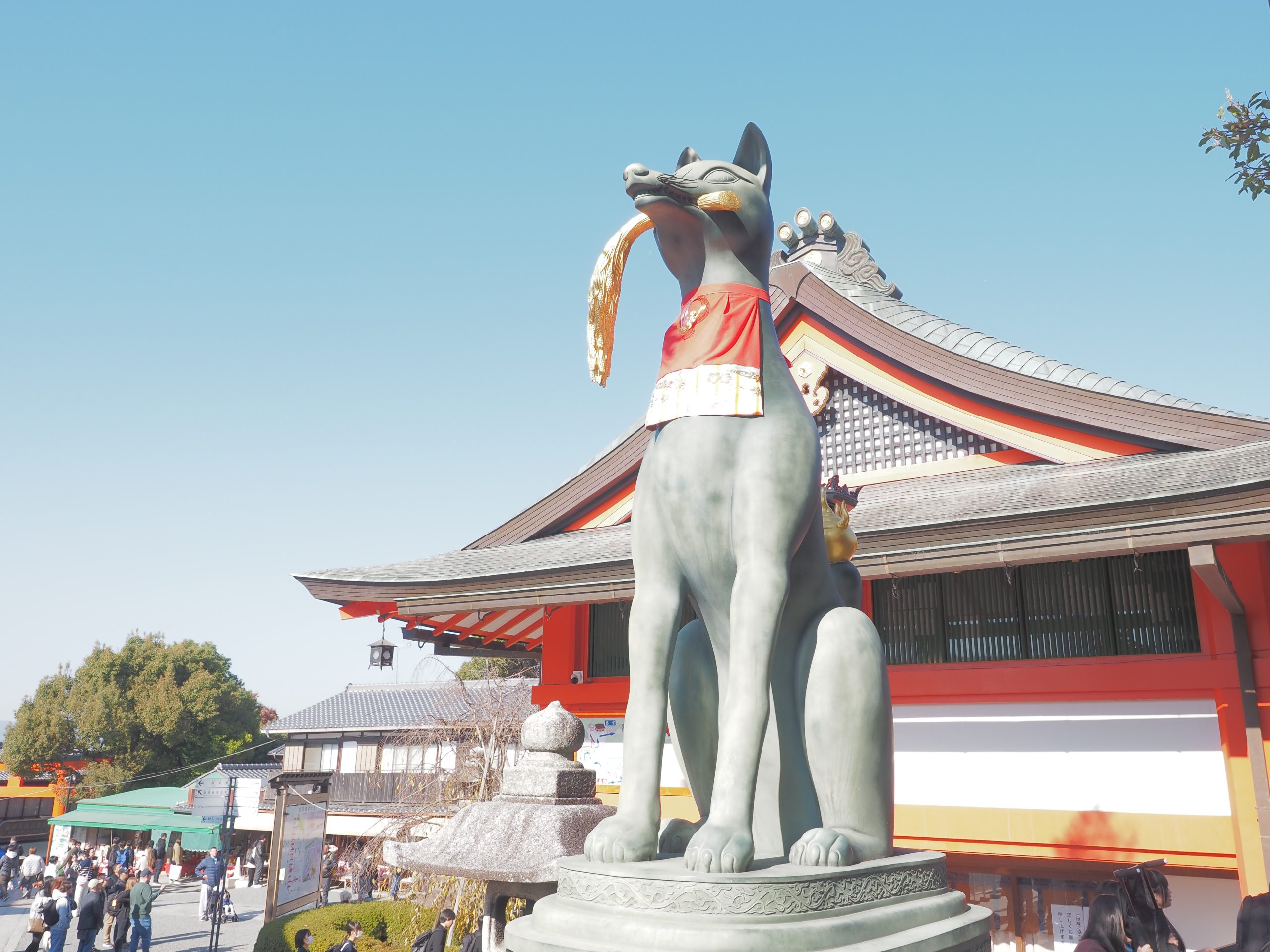
You may wonder why statues of a fox are placed in the precinct of Fushimi-inari Shrine. From the distant past when Japanese people adopted rice cultivation, the fox has been cherished as a sacred animal in contrast to Western countries where foxes are considered wily. This tendency has been attributed to the fox playing an important role in the paddy fields.
The most disgusting animals in paddy fields are rats. They nibble at sacred rice which has been grown at the expense of tremendous labor and time. The fox protects the rice from evil rats, which also happen to be a main source of food for the sacred fox. That’s why the Japanese consider the fox to be a messenger from heaven.
To provide more detail, you can find them holding things in their mouths; these include sacred rice, a scroll, a divided spirit from the Inari god, and a key. Sacred rice signifies a rich harvest, the scroll; wisdom, a divided spirit; a benefit from the Inari god, and the key; a wish for receiving the benefit.
Near Fushimi-inari Shrine, there are a number of deep-fried soybean curd restaurants because it’s said that deep-fried soybean curd is a fox’s second favorite food. You can have “Inari Zushi,” which is a ball of rice covered with vinegar-flavored deep-fried soybean curd, and “Kitsune Udon,” which is a bowl of wheat noodles with dashi-flavored soup and deep-fried soybean curd on top. Dashi is indispensable in making traditional Japanese soup. It is made of kelp seaweed also called kombu and katsuobushi, which is dried bonito flakes, and it enhances the taste of the ingredients. These are local foods that have been loved since the distant past, so if it happens to be lunchtime when you visit this shrine, please try them!
Magical stones that will make your wish come true
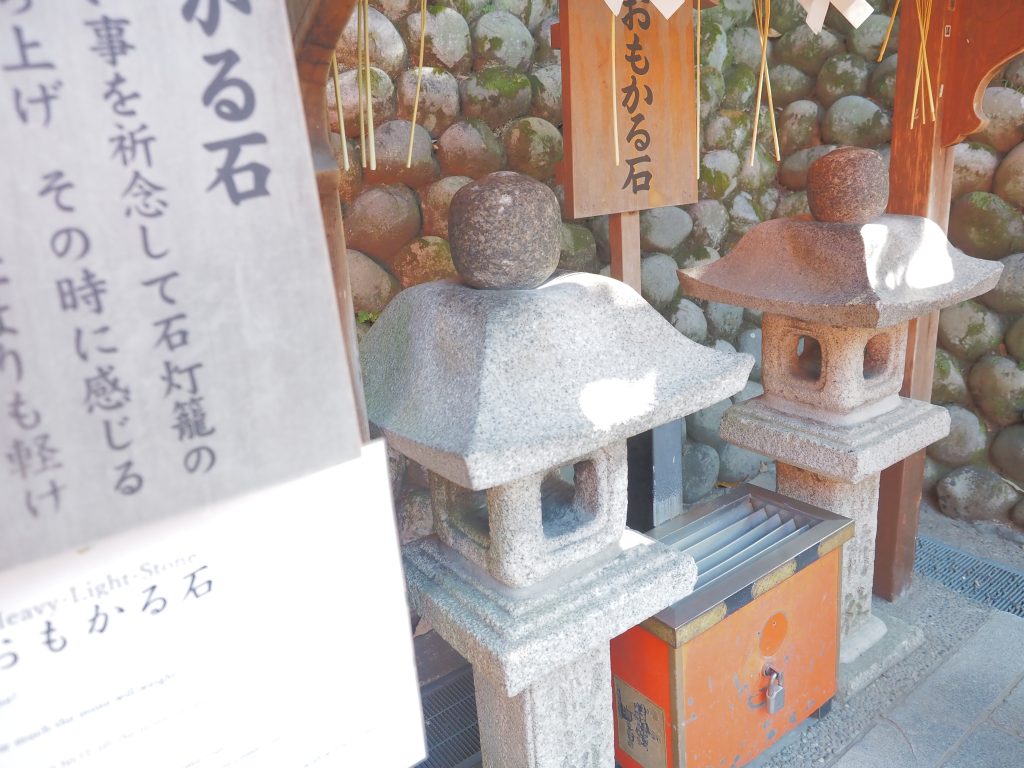
After passing through the thousand Torii gates, you will arrive at “Okunoin,” meaning a place that is located off the beaten track. Though this place has been frequently visited by many people recently and seems to no longer hold true to the original meaning, it still holds its majesty and reverence.
Walking further to the back on the right will lead you to a place where you can try your luck. In this place, there are two stone lanterns, with a stone the size of a football placed on top of each of them.
The magical stones are believed to make your wish come true if you feel it to be lighter than you previously predicted when you lifted the other stone.
I’m not sure how this custom has taken root, but this custom goes for some other Shinto shrines as well. But don’t take it seriously. Just enjoy trying your luck lifting the stones.
One suggestion on how to make your wish come true is to take for granted that it’s very heavy. Then you are likely to lift the stone with ease. This is just a joke of course, but it’s worthwhile trying for this once-in-a-lifetime experience.
Putting some money into an offertory box is not a requirement, but if you feel inclined to purify yourself, you can just donate some coins from your wallet before enjoying attempting to lift the magical stones. In the Shinto way of thinking, you may get possessed by evil spirits if you keep a lot of money all to yourself.